

A New Era in Aesthetic Medicine
Aesthetic medicine is constantly evolving. For years, the conversation around injectables was mostly centered on volume: restoring it, replacing it, or adding it where the face had changed over time. While volume still plays an important role in facial rejuvenation, the focus is becoming more refined.
Today, the goal is not simply to look fuller. It is to look healthier, fresher, and more naturally supported.
This shift has placed regenerative aesthetics at the center of modern treatment planning. Instead of only correcting visible signs of aging, regenerative treatments aim to support the skin’s own biological processes, helping improve skin quality, firmness, hydration, and long-term facial harmony.
It reflects a wider movement in aesthetic medicine trends in 2026, where patients are becoming more informed, and practitioners are looking beyond surface-level correction. The new standard is not about doing more to the face, but about helping the skin function better from within.
And that is where the Genefill range, especially Genefill DX, becomes part of a much bigger conversation.
What Is Regenerative Aesthetics?
Regenerative aesthetics refers to treatments that work with the body’s natural repair and renewal processes. Instead of simply adding volume or smoothing a line, the aim is to stimulate biological activity within the skin, supporting collagen production, tissue quality, and overall dermal strength.
In simple terms, regenerative aesthetics is about helping the skin do more of what it naturally does.
As we age, collagen production slows down, which leads to the skin gradually losing elasticity, firmness, hydration, and structural support. This is why the face can begin to look tired, less defined, or thinner over time, even when the change is subtle.
Traditional dermal fillers are often used to restore volume and support facial contours. Regenerative treatments take this further by focusing on the deeper quality of the tissue itself. This includes processes such as neocollagenesis, which refers to the formation of new collagen within the skin.
This is why terms like collagen stimulation, bio-remodelling, dermal integrity, and longevity in aesthetics are becoming more important. The future of aesthetics is not only about what can be corrected today. It is also about how the dermal matrix can be supported for tomorrow.
That shift naturally leads to a new generation of injectable treatments designed to combine immediate aesthetic improvement with longer-term skin support.
From Filling to Regenerating: Why the Approach Is Changing
The rise of regenerative aesthetics is also a response to a very real change in patient preferences. The “overfilled” look is no longer the goal. More people now want natural-looking results that preserve expression, identity, and facial balance.
This does not mean fillers are becoming less relevant. It means the way fillers are used is becoming more thoughtful.
Modern hyaluronic acid fillers are no longer viewed as simple volume replacement tools. When selected properly and placed with the right technique, they can support facial structure, restore hydration, improve contour, and contribute to a fresher appearance without making the face look heavy or overdone.
This is especially important in areas such as the cheeks, jawline, nasolabial folds, and perioral region, where small changes can make the face look more rested and balanced. The goal is to restore harmony in a way that still looks like the person, not to erase every sign of aging.
This is where the concept of prejuvenation also becomes relevant. Rather than waiting for more visible signs of aging changes to appear, many people are now choosing subtle, earlier interventions that help maintain skin quality and facial structure over time.
Regenerative aesthetics fits naturally into this mindset. It supports a more preventive, long-term approach, where skin health and facial balance are treated as part of the same journey.
The Role of Hyaluronic Acid in Skin Quality and Facial Rejuvenation
To understand why hyaluronic acid fillers remain so important in regenerative aesthetics, it helps to understand what hyaluronic acid actually does.
Hyaluronic acid, often referred to as HA, is a naturally occurring substance found in the skin and connective tissues. It is known for its ability to bind water, which helps support hydration, softness, and volume.
In aesthetic medicine, hyaluronic acid fillers are used to restore lost volume, smooth lines, enhance hydration, and support facial contouring. Depending on the formulation, HA fillers can be used for different purposes, from superficial skin hydration to deeper structural support.
Product design becomes an important factor, as not every filler behaves the same way. Some are softer and more suitable for fine lines or delicate areas, while others are designed to provide lift, projection, or support in deeper tissue planes.
With the rise of regenerative aesthetics, HA is no longer only valued for its ability to fill. It is also valued for how it contributes to hydration, smoothness, and tissue support as part of a broader rejuvenation plan.
This makes HA-based treatments a strong foundation for modern facial rejuvenation, especially when combined with technologies that support biostimulation and collagen activity.
Genefill and the Move Toward Smarter Injectable Treatments
The Genefill range reflects this evolution in aesthetic medicine. Rather than offering a single approach for every concern, it includes formulations tailored to different needs, depths, and treatment goals.
Some Genefill products are focused on structure and definition, while others are designed for fine lines, hydration, or surface refinement. This matters because the face is not one uniform area. The cheeks, lips, jawline, under-eye region, and skin surface all require different levels of support.
For example, Genefill Soft Fill may be considered where structure, definition, and deeper correction are needed. Genefill Soft Touch is better suited to delicate areas and fine lines where a lighter approach is preferred. Genefill Fine focuses more on hydration and skin quality, making it relevant in conversations around skin boosters and glow-focused treatments.
This kind of product variety allows treatment to become more personalized. Instead of simply asking, “Where should filler be placed?”, the better question becomes, “What does this tissue need?”
That is the difference between routine correction and modern regenerative thinking.
Genefill DX: A Hybrid Filler Approach to Regenerative Aesthetics
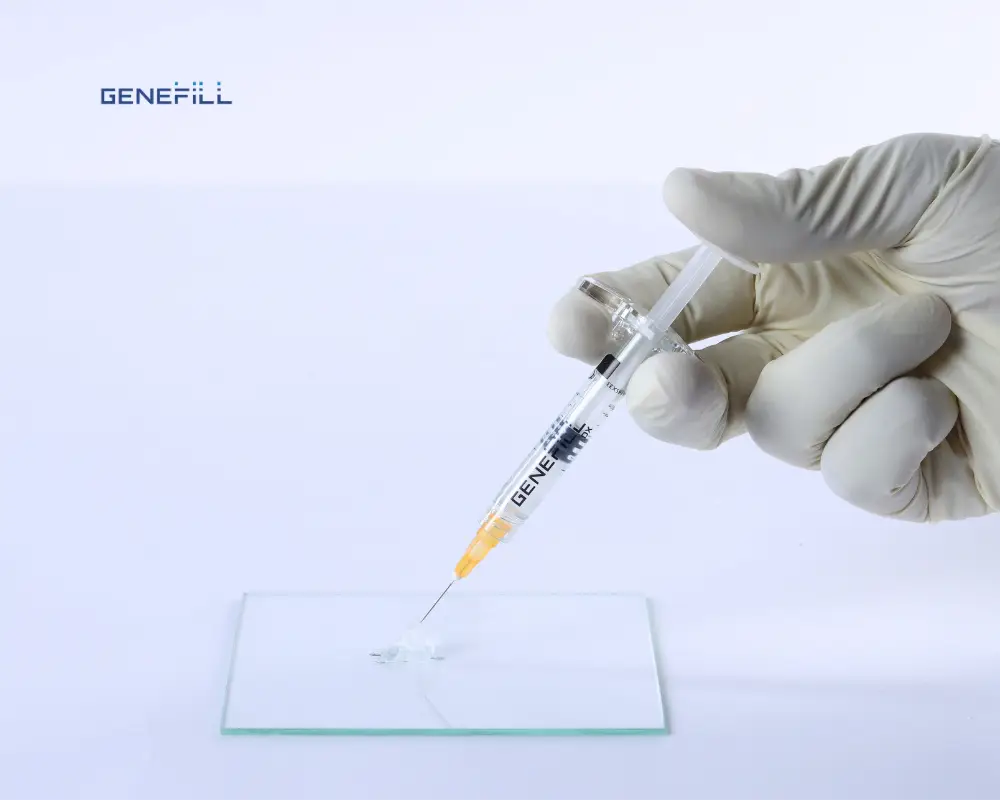
Among the Genefill range, Genefill DX is especially relevant to the conversation around regenerative aesthetics because it combines immediate correction with longer-term dermal support.
Genefill DX is a hybrid filler that combines hyaluronic acid with dextranomer microspheres. The hyaluronic acid component provides hydration, volume, and structural support, while the dextranomer component is associated with biostimulation and collagen activity over time.
This triple-action approach is important because it addresses three common goals in facial rejuvenation: visible improvement, hydration, and progressive skin support.
The HA component helps restore volume and improve contour where needed. Meanwhile, the dextranomer microspheres in fillers are designed to support the skin’s regenerative response, including collagen-related activity. This positions Genefill DX within the growing category of hybrid biostimulatory HA fillers, where treatment is not only about restoring volume, but also about supporting the quality of the tissue.
In aesthetic practice, this can be especially useful when the concern is not only volume loss, but also changes in texture, firmness, or overall skin vitality. Rather than creating an obvious “filled” appearance, the aim is to support results that look refreshed, balanced, and gradual.
This makes Genefill DX relevant for patients seeking natural-looking results, and for practitioners who are building treatment plans around facial harmony, tissue quality, and long-term skin health.1,2
Why Collagen Stimulation Matters
Collagen is one of the key proteins responsible for the skin’s firmness, structure, and resilience. As collagen levels decline with age, the skin can begin to lose support. This can contribute to fine lines, laxity, changes in facial contour, and a less firm appearance.3
This is why collagen stimulation has become one of the most important themes in aesthetic medicine.
Treatments that support collagen activity are designed to encourage the skin to rebuild some of its own internal support over time. This process is not instant in the same way volume restoration can be, but that is exactly what makes it valuable. It develops gradually, helping results look more natural and integrated.
In the context of regenerative aesthetics, collagen stimulation supports the idea that good aesthetic outcomes should not only look better on the surface but also contribute to better skin quality underneath.
This is also where terms like neocollagenesis, tissue repair, and dermal integrity become more than technical language. They describe a shift in thinking: from short-term correction to long-term skin support.
For many people, that is what makes regenerative aesthetics appealing. It feels less like changing the face and more like helping them age with better support.
Natural-Looking Results and the Future of Facial Contouring
One of the biggest reasons regenerative aesthetics is gaining attention is that it supports a more subtle approach to beauty.
The goal is not to freeze expression, over-project the face, or create features that feel disconnected from the person’s natural anatomy. Instead, regenerative treatments aim to improve what is already there: skin quality, contour, hydration, firmness, and balance.
This is especially important in facial contouring, where precision matters. A small amount of support in the cheek can soften tiredness. A refined jawline treatment can improve definition. Better hydration and skin quality can make the entire face look more rested without changing its character.
This approach also fits the modern preference for “quiet” aesthetic results. People want to look refreshed, but they do not necessarily want their treatment to be obvious. They want results that move with their face, fit their features, and age naturally over time.
Regenerative aesthetics supports this by focusing on gradual improvement, tissue quality, and facial harmony rather than dramatic transformation.
Regenerative Aesthetics and Prejuvenation
Another reason regenerative aesthetics is becoming more relevant is its connection to prejuvenation.
Prejuvenation is the idea of supporting the skin before deeper signs of aging become more visible. It is not about treating aging aggressively at a young age. It is about maintaining hydration, collagen support, elasticity, and facial balance in a thoughtful way.
For younger patients, regenerative treatments may help support skin quality and early structural changes. For more mature patients, they can complement volume restoration and contouring by improving the condition of the skin itself.
This makes regenerative aesthetics suitable across a wide range of treatment plans. It can be used for maintenance, refinement, correction, or long-term rejuvenation, depending on the patient’s needs.
The important point is that the treatment plan should always be personalized. Regenerative aesthetics is not a trend to follow blindly. It is a strategy that works best when guided by anatomy, product selection, and realistic expectations.
The Future of Aesthetic Medicine Is Skin-Led
The future of aesthetic medicine is not only about looking younger. It is about looking healthier, more balanced, and more like yourself.
That is why regenerative aesthetics has become such an important direction for 2026 and beyond. It reflects what patients are asking for and what practitioners are increasingly prioritizing: results that respect the skin, support the tissue, and enhance appearance without making it look artificial.
With its combination of HA-based support, product versatility, and hybrid technologies such as Genefill DX, Genefill fits into this new era of treatment planning. It supports a more thoughtful approach to facial rejuvenation, where hydration, volume, collagen stimulation, and skin quality all work together.
The result is not just a refreshed appearance today, but a smarter way to support the skin over time.
To explore whether Genefill is suitable for your goals, connect with us and take the next step toward a personalized regenerative aesthetics plan.
FAQs: Regenerative Aesthetics and Genefill DX
What is regenerative aesthetics?
Regenerative aesthetics refers to treatments that support the skin’s natural repair and renewal processes. Instead of only adding volume, these treatments focus on improving skin quality, collagen support, hydration, and long-term tissue health.
How is regenerative aesthetics different from traditional dermal fillers?
Traditional dermal fillers primarily focus on restoring volume, smoothing lines, or enhancing facial contours. Regenerative aesthetics goes further by supporting biological processes such as neocollagenesis, helping improve the quality of the skin over time.
What is Genefill DX?
Genefill DX is a hybrid filler that combines hyaluronic acid with dextranomer microspheres. The HA component supports hydration and volume, while the dextranomer component is associated with biostimulation and collagen-related activity.
Is Genefill DX a biostimulator?
Genefill DX is positioned within the category of biostimulatory HA fillers because it combines hyaluronic acid with components designed to support collagen activity over time. It offers both immediate correction and gradual skin quality support.
What are dextranomer microspheres in fillers?
Dextranomer microspheres are components used in certain injectable treatments to support biostimulation. In Genefill DX, they contribute to a regenerative approach by supporting the skin’s collagen-related response over time.
Does regenerative aesthetics look natural?
Yes, when performed by a qualified practitioner, regenerative aesthetics is designed to support natural-looking results. The goal is not to change the face dramatically, but to improve skin quality, restore balance, and support facial harmony.
Is regenerative aesthetics suitable for prejuvenation?
Yes. Regenerative treatments can be suitable for prejuvenation, especially for those looking to maintain skin quality, hydration, and collagen support before more visible signs of aging develop.
How long do Genefill DX results last?
Genefill DX is designed to provide results that may last up to 12 months. But results vary depending on the treatment area, technique, patient metabolism, and individual skin condition. It is designed to provide immediate improvement through HA support, with gradual enhancement linked to collagen stimulation over time.
Is Genefill DX suitable for skin laxity?
Genefill DX may be considered in treatment plans where mild skin laxity, volume loss, or reduced skin quality are concerns. A qualified practitioner can assess whether it is the right option based on the patient’s anatomy and goals.
REFERENCES:
- Ortiz-Flores RM, Escamilla-Sanchez A, Cidoncha-Morcillo B, Mastronardi L, Fontenete S, Garcia-Delgado R. Enhanced Facial Rejuvenation: Biostimulatory Effects of Hylan Gel Dermal Filler DX on Collagen Synthesis and Tissue Regeneration. Aesthetic Plast Surg. 2026 Jan;50(2):707-725.
- Ruiz N, Lopez RM, Marques R, Fontenete S. Clinical Outcomes and Safety Profile of a Dextranomer-Hyaluronic Acid Hybrid Filler: A Case Series Analysis. J Cosmet Dermatol. 2025 Jan;24(1):e16653.
- Shin JW, Kwon SH, Choi JY, Na JI, Huh CH, Choi HR, Park KC. Molecular Mechanisms of Dermal Aging and Antiaging Approaches. Int J Mol Sci. 2019 Apr 29;20(9):2126.
.webp)