Safety Is the Starting Point
When it comes to aesthetic treatments, people often consider several important questions, including “How dramatic will the result be?” “How long will it last?”, and, most importantly, “Is it safe?”
In modern aesthetic medicine, safety is not defined by one factor alone. It begins with the quality of the raw materials, continues through the manufacturing process, and is reinforced by regulatory assessment, clinical use, practitioner training, and ongoing product monitoring.
With Genefill dermal fillers, safety starts long before treatment takes place. The range is developed using hyaluronic acid of non-animal origin, supported by controlled manufacturing processes, and positioned within BioScience GmbH’s medical device quality framework.
For anyone considering treatment, this matters because the product being placed beneath the skin should be more than effective. It should be carefully developed, clinically considered, and designed with biocompatibility, performance, and patient safety in mind.
This blog explores the key factors behind Genefill safety and quality standards, including its formulation, its use of patented Advanced Thixotropic Technology, CE certification, post-market evaluation, reversibility, and the importance of trained professional use.
What Genefill Is Made Of: Non-Animal Origin Hyaluronic Acid
At the core of Genefill fillers is hyaluronic acid of non-animal origin, a material widely used in aesthetic medicine for volume restoration, contouring, hydration, and skin quality improvement. Produced using carefully selected raw materials, this formulation supports a consistent, tissue-compatible profile for professional use.
Individual suitability should always be considered as part of a personalized treatment approach. Medical history, skin condition, treatment area, and individual goals should always be assessed by a qualified practitioner. From a formulation perspective, the use of non-animal-origin hyaluronic acid is intended to support compatibility with human tissue and aligns with the characteristics commonly associated with hyaluronic acid-based dermal fillers.
In other words, safety does not begin at the moment of injection. It starts with the ingredients and formulation used to create the product.
Advanced Thixotropic Technology: Why Gel Behavior Matters
A dermal filler is not only defined by its ingredients. It is also defined by how the gel behaves during and after injection.
This is where Advanced Thixotropic Technology, also known as ATT, becomes important.
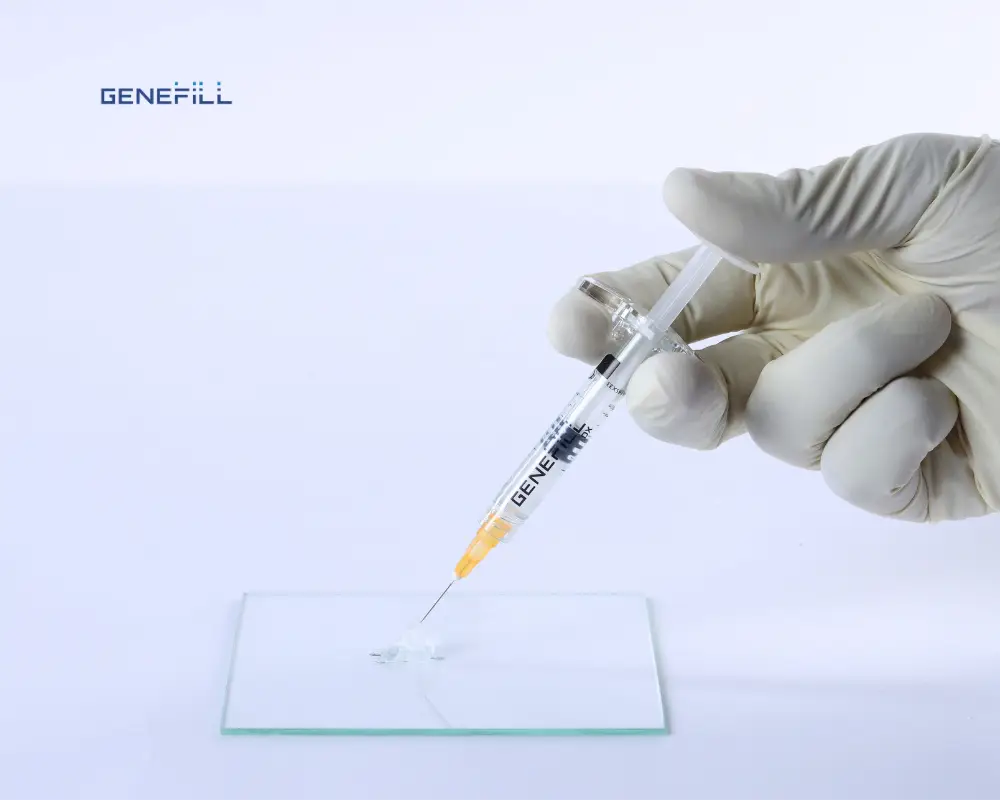
Thixotropy refers to the way a gel changes under pressure. In the case of Genefill, the gel is designed to become less viscous during injection, allowing it to flow more smoothly through the syringe and needle. Once the injection pressure is released, the gel is designed to return toward its original structure within the tissue.
This matters because gel behavior can influence the treatment experience, product placement, and the predictability of the final result.
For practitioners, a gel that flows smoothly under pressure may support more controlled placement and precise application. For patients, this can contribute to a smoother treatment experience and confidence in the consistency of the outcome.
The goal is not simply to make injection easier. It is to support a balance between injectability and stability, allowing the product to be placed effectively while maintaining the structural qualities needed for aesthetic correction.
This balance is one of the defining aspects of the Genefill formulation and helps support its overall handling and performance.
CE-Certified Dermal Filler: What the CE Mark Means
Genefill is CE-certified under certification number 2409, meaning it has been assessed against European requirements for safety, performance, and quality as a medical device.
The CE mark represents more than a label. To obtain it, a medical device must undergo regulatory evaluation and be supported by quality management systems, technical documentation, and ongoing oversight.
For practitioners and patients, this provides an added level of confidence that the product has been reviewed within a recognized medical device framework rather than relying solely on manufacturer claims.
CE certification is one of the key indicators of the brand’s quality standards, reflecting its alignment with established European requirements for safety, performance, and quality. Combined with high-quality formulation and use by trained professionals, it contributes to the broader safety profile of the Genefill range.
Clinical Use, Post-Market Follow-Up, and Real-World Safety
Aesthetic products should not only be evaluated before they reach clinics. They should also be monitored after they are used in real-world practice.
This is where post-market evaluation becomes important.
BioScience GmbH, the manufacturer behind Genefill, has more than two decades of experience in research, development, and medical aesthetic product manufacturing. That experience informs how the brand’s range is developed, tested, and refined over time.
Post-market clinical follow-up, often referred to as PMCF, is designed to observe how a medical device performs after it has entered clinical use. This can include patient satisfaction, treatment outcomes, reported side effects, and overall product performance in real-world settings.
Clinical experience and post-market evaluation have supported the safety and performance profile of Genefill DX. Published findings can provide useful insight into how the product performs in real-world clinical settings beyond the development phase.
READ NOW: Enhanced Facial Rejuvenation: Biostimulatory Effects of Genefill DX
Of course, no injectable treatment is completely without risk. Mild swelling, redness, tenderness, or bruising may occur after treatment, as with many injectable procedures. More serious complications are less common but require appropriate clinical knowledge and management.
That is why a strong safety profile depends on both the product and the person using it.
A Closer Look at Genefill DX and Hybrid Filler Design
Genefill DX is a useful example of how formulation design can support both aesthetic performance and long-term treatment planning.
It is a hybrid biostimulatory HA filler that combines cross-linked hyaluronic acid with dextranomer microspheres. The HA component supports immediate correction, hydration, and structure, while the dextranomer component is associated with gradual collagen-related activity over time.
This makes Genefill DX relevant in treatment plans where both volume and skin quality are being considered.
Rather than focusing only on filling space, the hybrid approach reflects a wider shift in aesthetic medicine: treatments are increasingly expected to support facial harmony, hydration, tissue quality, and natural-looking results.
From a safety and quality perspective, the important point is that Genefill DX is developed within the same manufacturing and quality framework as the rest of the brand’s filler range. Its role is not to replace practitioner judgment, but to offer another formulation option for carefully selected cases.
As with any injectable treatment, suitability should always be assessed by a trained medical professional based on anatomy, skin condition, treatment goals, and patient history.
Minimally Invasive Treatment, With Proper Clinical Consideration
One of the reasons Genefill hyaluronic acid fillers are appealing in modern aesthetic practice is that they are minimally invasive.
There is no surgery and no general anesthesia required. In many cases, patients can return to their normal routine shortly after treatment, depending on the area treated, the technique used, and individual response.
This makes HA filler treatments suitable for people with active schedules, but it is important to keep the message balanced: minimally invasive does not mean casual.
Every injectable treatment requires proper assessment and planning. The practitioner must consider the patient’s anatomy, medical history, expectations, treatment area, product choice, injection depth, and possible risks.
Mild swelling, redness, bruising, or tenderness may occur, and these effects are usually temporary. A qualified practitioner can guide patients on aftercare, expected recovery, and when to seek follow-up support.
The safest aesthetic outcomes are never based on the product alone. They come from combining a high-quality filler with careful planning, realistic expectations, and skilled clinical technique.
Can It Be Dissolved or Reversed?
One of the most important safety advantages of hyaluronic acid-based dermal fillers is that they may be adjusted or dissolved when clinically appropriate.
Because Genefill is HA-based, it can be reduced or dissolved using an enzyme called hyaluronidase. This should only be done by a qualified medical professional in a clinical setting, after proper assessment.
This reversibility is a meaningful difference between HA fillers and more permanent aesthetic materials. If a result needs adjustment or if there is a clinical reason to reduce the product, hyaluronidase provides an option that supports flexibility and responsible treatment management.
This does not mean filler treatments should be taken lightly. The goal is always to plan carefully from the beginning, choose the correct product, and use the right technique.
But knowing that HA fillers are adjustable gives practitioners and patients an added level of reassurance, especially when compared with permanent or non-reversible materials.
Why Qualified Practitioners Matter
Genefill dermal fillers are professional medical devices intended for use by trained and qualified aesthetic practitioners. They are not suitable for self-administration.
This point is essential.
Even the best filler must be used correctly. The safety of any injectable treatment depends on anatomical knowledge, injection technique, product selection, dosage, placement, and the ability to recognize and manage potential complications.
A qualified practitioner will assess whether the treatment is appropriate, explain the expected outcome, discuss possible side effects, and select the right Genefill formulation for the treatment area and goal.
BioScience GmbH also supports professional education through resources such as the BioScience Digital Academy, helping practitioners strengthen product knowledge, treatment understanding, and responsible clinical use.
For patients, this means the choice of practitioner matters as much as the choice of product. For professionals, it reinforces the importance of continued training, safe technique, and evidence-informed treatment planning.
The Bottom Line: Making Informed Choices
When it comes to aesthetic treatments, safety and quality should always come first. Choosing a well-established product and seeking treatment from a qualified practitioner are key steps toward achieving results that are both effective and appropriate for your individual needs.
Genefill is designed to support modern aesthetic treatment plans with a focus on quality, consistency, and natural-looking outcomes. However, the best results always begin with a thorough consultation and a personalized approach.
If you are considering treatment, contact us to learn more about Genefill and connect with a qualified practitioner who can assess your goals, discuss suitable options, and guide you toward an informed treatment decision.
FAQs
Is Genefill a hyaluronic acid filler?
Yes. Genefill is a hyaluronic acid-based dermal filler range made with non-animal origin HA. Depending on the formulation, it may be used for volume restoration, facial contouring, hydration, fine line refinement, or skin quality improvement.
What is Genefill made of?
Genefill is made of biphasic hyaluronic acid sourced from non-animal origin. Hyaluronic acid is naturally found in the body and is widely used in aesthetic medicine due to its role in hydration, tissue support, and volume restoration.
Is Genefill CE certified?
Yes. Genefill is CE-certified under certification number 2409, meaning it has been assessed within a European medical device framework for safety, performance, and quality.
Is Genefill filler safe?
Genefill is developed using high-quality non-animal origin hyaluronic acid and is CE-certified. When administered by a trained and qualified practitioner, it can be used safely in appropriate patients. As with all injectable treatments, suitability and risk should be assessed individually.
What is Advanced Thixotropic Technology?
Advanced Thixotropic Technology, or ATT, refers to the way Genefill gel is designed to behave under injection pressure. The gel flows during injection and then returns toward its original structure once placed in the tissue, supporting controlled placement and product stability.
How long does Genefill last?
Results depend on the product used, the treatment area, injection technique, and individual factors such as metabolism and lifestyle. As a general guide, Genefill Soft Fill, Genefill DX, and Genefill Soft Touch may last up to 12 months, while Genefill Fine is a skin booster focused on hydration and skin quality with a shorter duration of up to 30 days.
Will I have downtime after Genefill treatment?
Most patients can return to their normal routine shortly after treatment, depending on the area treated and individual response. Mild swelling, redness, bruising, or tenderness may occur but is usually temporary.
Can Genefill be dissolved or reversed?
Yes. Because Genefill is a hyaluronic acid-based filler, it may be reduced or dissolved with hyaluronidase when clinically appropriate. This should only be performed by a qualified medical professional in a clinical setting.
Who can administer Genefill?
Genefill should only be administered by trained and qualified aesthetic practitioners. Safe treatment requires patient assessment, anatomical knowledge, correct product selection, precise injection technique, and the ability to manage possible complications.
Is Genefill suitable for all patients?
Not every patient is suitable for dermal filler treatment. A qualified practitioner should assess medical history, treatment goals, skin condition, anatomy, and the intended treatment area before recommending Genefill.